


A payline is a set path across the reels where matching symbols trigger a payout. The basic idea: three or more identical symbols from left to right – but only if they land on an active line.
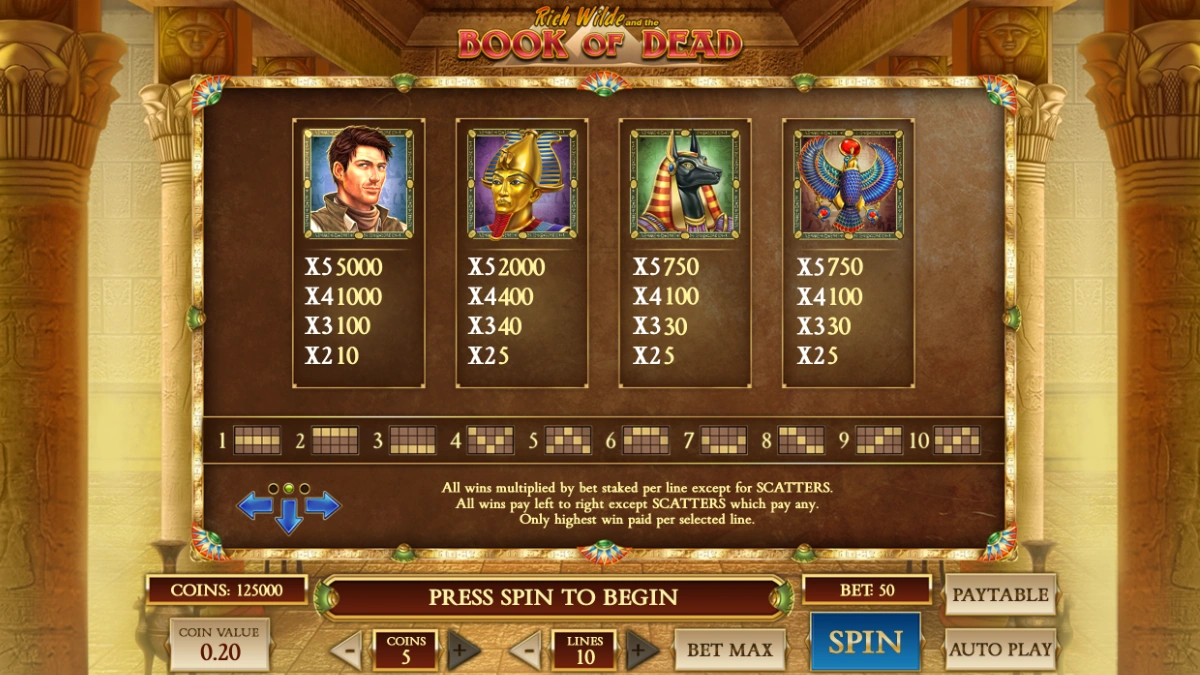
Back in the days of the original one-armed bandit, this was dead simple: one reel, one line, straight across the middle. Modern online slots run 10, 20, or even 40 of these paths – horizontal, diagonal, zigzag. Book of Dead, for example, has 10 paylines running in different directions across five reels. Here’s what matters: if three explorers land on an inactive line, you’ll see the symbols on screen – but you won’t get paid.
Four ways slots pay out
This is where it gets interesting, because classic paylines are far from the only game in town. Modern slots use four different systems to determine wins.
| System | How it works | Example slot | Best for |
|---|---|---|---|
| Paylines | Fixed paths from left to right, often adjustable | Book of Dead | Beginners who like clear structures |
| Ways to Win | Matching symbols on consecutive reels, regardless of position | Immortal Romance | Players who don’t want to manage lines |
| Megaways | Random number of symbols per reel, up to 117,649 ways | Bonanza Megaways | Players chasing high volatility |
| Cluster Pays | At least five matching symbols in a connected group, chain reactions possible | Reactoonz 2 | Players who want a break from traditional reels |
1. Classic paylines
Fixed or adjustable paths running left to right – the system described above. You’ll find it in slots like Book of Dead (10 lines) or Ramses Book (5 lines). Some slots let you choose how many lines to activate, which directly affects your bet size and volatility.
2. Ways to Win
No fixed paths here. Matching symbols just need to appear on consecutive reels – doesn’t matter where exactly. Three reels with three symbol positions each give you 3 × 3 × 3 = 27 possible combinations. The standard setup: 243 ways to win. The upside is obvious: you don’t need to hope for a specific line – if the symbols match across reels, you win.
3. Megaways
Megaways is the turbocharged version of Ways to Win, developed by Big Time Gaming. Each spin loads a random number of symbols onto every reel – anywhere between two and seven. That means the number of possible winning combinations shifts with every single spin. The ceiling with 6 reels at 7 symbols each: 7 × 7 × 7 × 7 × 7 × 7 = 117,649 ways to win. Slots like Bonanza and The Dog House Megaways use this system.
4. Cluster Pays
No grid, no lines – just a playing field. At least five matching symbols touching horizontally or vertically trigger a win. Reactoonz 2 is a textbook example. Winning symbols vanish, new ones drop in, and chain reactions from a single spin become very real.
Tip
Whether you even see ‘paylines’ depends on the type of slot you’re playing. Many modern casinos mix these systems, so it’s always worth checking the paytable before your first spin.
Adjusting paylines yourself
On classic payline slots like Book of Dead, you can set the number of active lines yourself – usually anywhere from 1 to 10. On Ways to Win and Megaways slots, that’s not an option. All winning paths are always active, and the only thing you control is your bet per spin.
Reducing the number of lines lowers your bet per spin, but it also cuts the frequency of your wins. You end up paying roughly the same effective amount per winning chance – just with longer dry spells in between. That’s not a glitch, that’s by design.
5 or 10 lines – what’s the real difference?
The difference comes down to volatility, not overall win probability. Let’s look at a concrete example: Book of Dead (10 lines) vs. Ramses Book (5 lines) – both at a $1 bet.
With Book of Dead, wins land more often because there are more active paths. But each individual win is smaller. Five explorers in a row pay around $500 on Book of Dead versus $1,000 on Ramses Book – because the hit is rarer, so the payout scales up.
More lines mean more frequent wins, smaller amounts, and a bankroll that lasts longer. Fewer lines mean rarer wins, bigger individual payouts, and a higher risk of your balance taking a hit in between.
Which model suits you depends on how you like to play. If you enjoy seeing regular wins roll in, more lines are your thing. If you can stomach 20 dead spins waiting for a bigger hit, try dialling the lines back.
One thing worth being blunt about: reducing lines just to lower your bet sounds clever, but it’s a trap. You’re swapping steady small wins for brutal dry spells and calling it bankroll management. If $1 per spin is too much, lower the coin value. If the slot is too expensive, pick a different one. Don’t mess with the line count and then wonder why you hit 30 empty rounds in a row.
Would that winning combination have appeared on 10 lines?
This question comes up constantly in the community: ‘I had the explorers on a position – that would have been a win on 10 lines. If I’d activated more lines, would I have cashed in?’ Understandable frustration, but the logic doesn’t hold up.
A slot determines the outcome of every spin the moment you hit the button – through a Random Number Generator (RNG). The symbols on screen are just the visual representation of a result that’s already been decided. If you had activated more lines at that exact moment, the RNG would have generated a completely different outcome – different symbols, different positions. The picture would have changed, not just the lines.
The takeaway: inactive lines aren’t missed opportunities. They fundamentally change the game, because every spin configuration produces its own unique result.
Megaways: when paylines don’t matter
With Megaways slots, the question of how many lines to play becomes irrelevant. All winning paths are always active, and the number of ways shifts automatically with every spin. What the system does bring is its own kind of suspense: you never know how many ways you’re going into the next spin with.
The catch: Megaways slots tend to be highly volatile. Wins come less often, but they can be significantly larger when they do. If you prefer a more relaxed session and want to protect your balance, classic payline slots are usually the calmer choice. We break this down further in our guide to slot volatility.
How many paylines should you play?
I don’t have a universal answer for you – but I do have a few clear rules of thumb.
If you’re new or just want a chill session, slots with fixed paylines and a mid-range line count (10–20) are the most approachable. You know what you’re getting, and wins come in often enough that you won’t close the tab in frustration after ten spins.
If you’re chasing a big hit and can handle the dry spells, Megaways or Cluster Pays slots are worth a look – more chaos, more potential.
And if you’re reducing lines on a classic slot just to lower your bet: that’s a legitimate choice, but go in with your eyes open. Your balance will swing harder, and the cold streaks will run longer. No tricks involved, just slot maths.